

Frequent Production Line Shutdowns & Positioning Deviations? The Encoder Pitfall 90% of Factories Fall Into!
Author:珠海得尔堡科技有限公司
Click:
Time:2026-06-22 11:07:59
Frequent Production Line Shutdowns & Positioning Deviations? The Encoder Pitfall 90% of Factories Fall Into!
If you work with automated equipment or production line operation and maintenance, you have almost certainly encountered these frustrating issues:
The system powers up normally, yet unexpected positioning drift, unstable speed feedback, and intermittent shutdown faults occur out of nowhere.
After hours of troubleshooting, you rule out faults in motors, servos, and wiring—only to find the root cause lying in a tiny, easily overlooked component: the encoder.
Worse still, newly replaced encoders often fail again shortly after installation. Repeated downtime, spare part consumption, and excessive maintenance labor accumulate continuously, creating long-term hidden costs for most manufacturing plants.
Known as the 'neural endings of automated equipment', encoders undertake core tasks of high-precision speed measurement, positioning, and displacement feedback. 90% of automated production line failures stem from underestimated precision components.
This article avoids empty theoretical discourse and focuses on real-world industrial pain points, practical fault avoidance strategies, and professional encoder solutions tailored for heavy-duty industrial conditions.

01 Why Do Your Encoders Fail Frequently?
Many technicians assume encoders feature simple structures and mature technology, so universal models can fit all application scenarios.
However, industrial applications demand far more than basic functionality. There is no best encoder, only the one that best matches your on-site working conditions. Most recurring failures result not from poor product quality, but from improper model selection and mismatched application scenarios.
Below are the four most prevalent issues troubling 90% of manufacturing facilities:

1. Environmental Interference & Pulse Loss Caused by Micro-Vibration
Machine tools, packaging systems, logistics conveying equipment, and heavy-duty machinery frequently operate under continuous vibration and mechanical impact. Conventional encoders lack robust vibration resistance; their internal gratings and code discs are vulnerable to mechanical stress, directly causing pulse loss, positioning deviation, and dimensional inaccuracies, which drastically increase product scrap rates.
2. Inadequate Dust & Moisture Protection Leading to Premature Failure

Woodworking, chemical, food processing, and textile workshops are filled with airborne dust, oil contamination, and humid vapor. Standard encoders adopt low-grade sealing structures that allow fine impurities to penetrate and abrade core internal components. This triggers intermittent faults in the early stage and permanent jamming or breakdown in the long run, requiring frequent component replacement.
3. Insufficient Anti-Interference Performance Triggering Signal Abnormalities
Industrial sites are densely populated with inverters, motors, and high-voltage circuits, generating severe electromagnetic interference (EMI). Low-end or general-purpose encoders lack reliable signal shielding, resulting in signal fluctuation, feedback latency, and communication errors that cause unplanned equipment shutdowns, program faults, and reduced overall line throughput.
4. Blind Low-Cost Pursuit Leads to Higher Long-Term Operational Costs
Many factories opt for low-cost generic encoders to cut procurement expenditure. While seemingly cost-effective upfront, this choice leads to frequent replacements within three months, repeated downtime, rework, and excessive labor overhead. The cumulative losses far outweigh the price gap of high-quality products. Cheap component upgrades are essentially false economy that sacrifices long-term operational stability.
02 Current Encoder Industry Status: Severe Homogenization & Uneven Quality
The current global encoder market exhibits clear market polarization.
International premium brands deliver stable performance but come with steep price premiums, extended lead times, and sluggish after-sales support. Once a fault occurs, long waiting periods for spare parts will directly delay production schedules.
The low-end domestic market remains disordered: most products rely on low-price homogenization, simplified craftsmanship, and exaggerated parameter labeling. Despite advertised high-precision specifications, they frequently malfunction in actual industrial environments and fail to withstand continuous heavy-duty operation.
The core goal of industrial upgrading is not ultra-low procurement prices, but minimized downtime costs. What the industry truly demands is not low-priced encoders, but industrial-grade products with high stability, strong scenario adaptability, superior cost performance, and responsive after-sales services.
Focusing on industrial sensing and motion control technology, Delburg targets core application pain points of encoders and launches a full series of high-performance encoders. Our products are customized for diverse industrial scenarios, effectively resolving equipment instability, short service life, and high operational costs for manufacturing enterprises.
03 Delburg Encoders: Targeted Solutions for All Industrial Site Pain Points
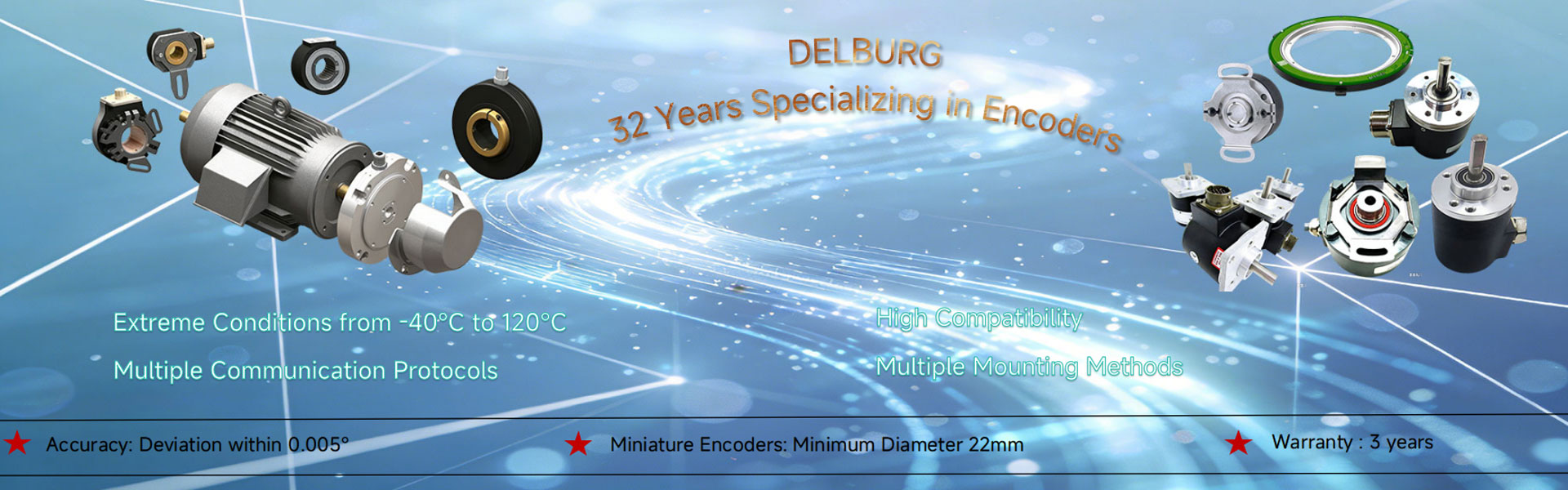
We do not chase flashy paper parameters, but practical on-site adaptability.Impressive theoretical data is merely an advantage; reliable and durable field performance is the core benchmark. Fully optimized for vibration resistance, dustproofing, anti-interference, and temperature adaptability, Delburg encoders are widely applicable to machine tools, packaging machinery, logistics conveying systems, printing equipment, textile machinery, heavy-duty machinery, automated production lines, semiconductor devices, phased array radar, and other industrial facilities.
✅ Superior Vibration & Impact Resistance, Eliminating Vibration-Induced Pulse Loss
Featuring high-precision code discs and a reinforced internal structure with optimized fixing craftsmanship for core components, our encoders achieve exceptional vibration and shock resistance. They maintain consistent pulse output under continuous equipment vibration and frequent start-stop impacts, fundamentally eliminating positioning drift, dimensional errors, and data inaccuracies to ensure long-term high-precision equipment operation.
✅ Advanced Sealing & Protection for Harsh Industrial Environments
Equipped with upgraded integrated sealing technology and industrial-grade high protection ratings, our encoders effectively block the intrusion of dust, oil stains, and water vapor. They operate stably in humid chemical environments, dusty woodworking workshops, and oil-intensive mechanical scenarios, significantly extending service life and reducing frequent replacement frequency.
✅ Enhanced EMI Shielding, Zero Signal Fluctuation
Adopting exclusive shielding structures and optimized circuit design, Delburg encoders withstand complex electromagnetic interference on industrial sites. In environments densely installed with inverters and motors, they deliver stable signal transmission, precise real-time feedback, and zero latency or signal disorder, completely eradicating intermittent faults and unexpected equipment shutdowns.
✅ High Precision & Low Tolerance for Rigorous Production Standards
All products undergo multi-process precision calibration before delivery, with authentic and reliable technical parameters. They support high-accuracy speed measurement, positioning, and displacement feedback, meeting rigorous technical standards for high-precision machining, precision sorting, and synchronous transmission, helping factories minimize scrap rates and boost production yield.
✅ High Cost-Effectiveness & Responsive After-Sales Service to Lower Overall Costs
Compared with imported brands, Delburg encoders offer more accessible pricing, faster delivery cycles, and no lengthy lead times. Compared with low-end generic products, they deliver comprehensive advantages in performance, operational stability, and durability, eliminating downtime losses caused by repeated replacements and troubleshooting.
In the long run, our encoders effectively reduce manufacturers’ spare part procurement costs, downtime economic losses, and labor operation and maintenance expenses, realizing genuine production cost reduction and efficiency improvement.
04 A Message to All Industrial Practitioners: Stable Accessories Ensure Stable Production Capacity
Most factories focus heavily on the precision and performance of mainframe equipment, yet overlook the critical role of encoders as core supporting components.
The core logic of automated manufacturing remains consistent: Precision defines the upper limit of product quality, while stability defines the lower limit of production capacity.
Inferior encoders can bottleneck the efficiency of the entire production line; reliable, high-stability encoders enable long-term, low-fault, high-load operation of automated equipment.
No more frustration from recurring equipment faults, no more economic losses caused by repeated component replacement, no more productivity waste from unplanned downtime and rework.
Top brands compete on technical parameters, while factories compete on operational stability. A reliable encoder serves as the invisible core productivity of production lines. With industrial-grade quality and craftsmanship, Delburg encoders secure the precision and stability of every automated production line.
???? For encoder selection guidance, working condition matching, sample testing, and bulk quotation inquiries
Prev : Encoder Electrical Anti-Interference Solution, Universal for New Project Design and Old Equipment RectificationNext : Detailed Explanation of 4 Encoder Output Types! Line Driver, NPN Open Collector, Push-Pull & Voltage Output Selection Guide
文章推荐
Delburg & ACCU-CODER Encoders: Direct Drop-in Replacement for Encoders from Europe, America, Japan & South Korea
Encoder Products Company Introduces 36RT/H Accu-CoderPro® High Resolution Programmable Encoder
Installation Methods of Encoders
Transmissive vs Reflective Photoelectric Encoders: Principles, Pros & Cons, and Selection Guide
High-Precision Positioning: Grating + Encoder Dual-Loop Servo System Eliminates Mechanical Transmission Errors
Poor Positioning Accuracy? Stop Blaming Encoders! The Real Errors Come From Transmission Chains
Encoder resolution and accuracy: What’s the difference?
Poor Positioning Accuracy? Stop Blaming Encoders! The Real Errors Come From Transmission Chains
High-Precision Encoders: Reliable Motion Sensing Solutions for Industrial Automation
Industrial Encoder Purchase Risk Avoidance Guide: Full Analysis of Channel Screening, Qualification Verification and Practical Implementation
Encoder Electrical Anti-Interference Solution, Universal for New Project Design and Old Equipment Rectification
Long Lead Time of Imported Encoders? Choose DELBURG for Cost Reduction & Technical Renovation
What Makes High-End Encoders Stand Out? 6 Core Standards for Industrial High-Quality Performance
Encoder Selection Guide
Encoder Fault Diagnosis and Prevention Checklist (Including On-site Inspection List)
Encoder Angular Accuracy: In-depth Conversion Manual for Arcminutes/Arcseconds
Professional Selection Guide for Servo Motor Encoders
DELBURG Encoder Brand Story
Zhuhai Delburg Technology Co., Ltd.
Rm.407, Building 4, No. 615 Huawei Road,
Xiangzhou District, Zhuhai City, 519000, China
Phone: 86-756-3363470
Email : delburg123@outlook.com

点击右上角
分享给朋友吧

Copyright © 2005-2015 MySite Ltd. All Rights Reserved. 粤ICP备2024309016号
