

Aerospace and Military Industry
Author:珠海得尔堡科技有限公司
Click:
Time:2025-06-05 12:19:01
The application of encoders in the field of aerospace and military industry
The application of encoders in the field of aerospace and military industries is based on 'high precision, high reliability, and extreme environment adaptability, and runs through key scenarios such as spacecraft attitude control, missile guidance, aerodynamic monitoring, and radar antenna positioning.' Its technical design needs to meet aerospace-grade standards (such as NASA-STD-6001), and it has special properties in terms of radiation resistance, extreme temperature resistance, vibration and shock resistance, etc. The following is an analysis of typical application scenarios, technical characteristics, special designs and cases.:

Encoder applications in spacecraft attitude and orbit control
Angle monitoring of reaction wheel and momentum wheel: Satellites (such as Beidou navigation satellite) generate torque through high-speed rotation of reaction wheels to realise three-axis attitude adjustment of pitch, yaw and roll, and real-time monitoring of wheel speed and position.
Technical solution: a dual-channel absolute photoelectric encoder (resolution 24 bits, angular accuracy ±0.0004°), installed on the reaction wheel spindle, through the harmonic reducer (reduction ratio 1:100) to convert high-speed rotation (3000rpm) into high-precision angle signal; The disc material is quartz glass, the surface is chrome-plated grating (line width 1 μm), and the space radiation resistance (total dose≤ 100 krad).Extreme environment design: operating temperature range -40°C~ 85°C (space hot and cold cycle), built-in constant temperature heating film (power consumption≤5W);

Anti-vibration index: 10~2000Hz, 50G acceleration, to meet the impact of the launch stage of the launch vehicle.
2. Solar wing drive mechanism (SADA) position control, core requirements: The solar wing of the space station needs to be aligned with the sun at all times, the rotation accuracy of the drive mechanism needs to be ±0.1°, and the encoder needs to work stably in a vacuum environment (10⁻⁶Pa).
Encoder selection: Magnetoresistive multiturn absolute encoder (e.g. EPC A58SE series), non-contact measurement to avoid wear, no risk of grease volatilisation in vacuum environment, and the output SSI signal is transmitted to the onboard computer via an aerospace-grade cable (silver-plated shield).
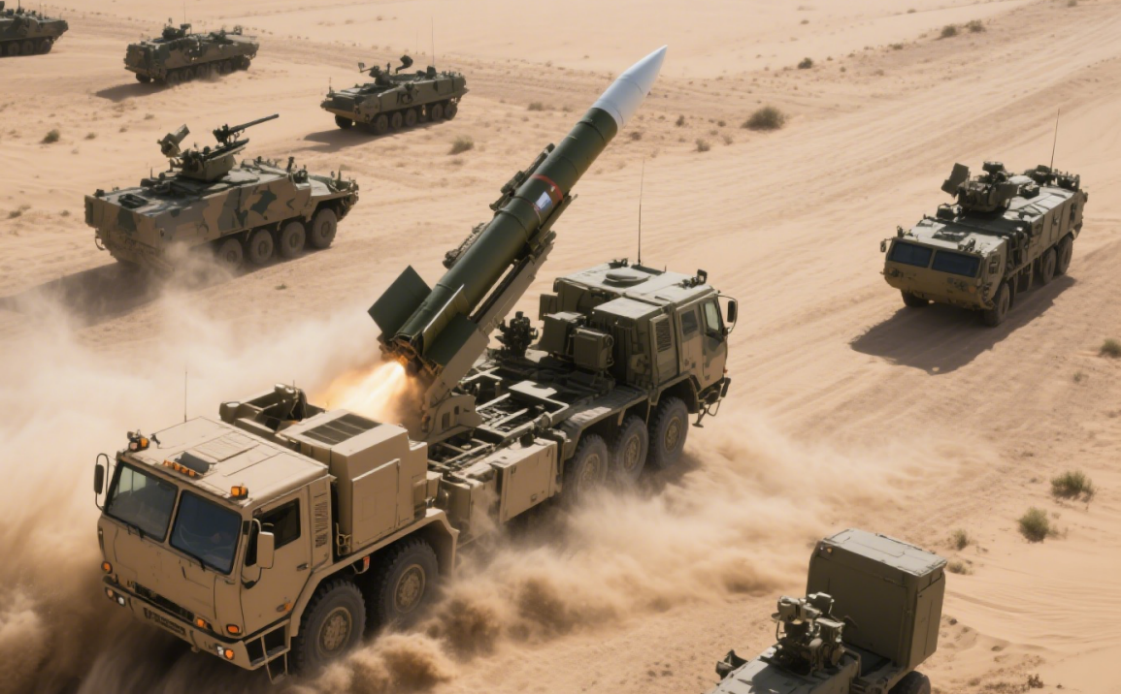
Encoder applications in missile guidance and weapon systems
1.Frame angle measurement of inertial navigation platform: The three-axis stabilised platform of the inertial navigation system of ICBMs (such as Dongfeng series) needs to monitor the frame rotation angle in real time to ensure the guidance accuracy (circular probability error CEP≤50m).
Technical features: A three-degree redundant resolver is adopted, each channel has independent power supply and signal output, and the system automatically switches to the redundant channel when a single channel fails; - Temperature resistance range -55°C to 125°C, adapting to the high temperature of the engine tail flame when the missile is launched, and the shell is made of a titanium alloy with a heat-proof coating (thermal conductivity ≤ 0.5W/m·K)
2.Guided bomb rudder deflection control, solution: install a miniature photoelectric encoder (diameter 12mm, resolution 16 bits) at the rotating shaft of the bomb aerodynamic rudder surface, measure the rudder surface deflection angle (range±30°, accuracy ±0.05°), and feed back to the flight control system to achieve accurate guidance at the end (such as JDAM bomb hit accuracy ≤10m).
Aero engine and powertrain monitoring
Turbofan engine rotor speed measurement: The high-pressure rotor speed of the fighter engine (such as the F119-PW-100 of the F-22) exceeds 30,000rpm, and it needs to be monitored in real time to prevent overspeeding (emergency shutdown is triggered when the overrun value is ±5%). Encoder technology: high-temperature magnetoelectric encoder (operating temperature≤ 200°C), using Hall element array (16-bit sampling), converts high rotational speed into a measurable signal through gear meshing (transmission ratio 1:5); Anti-electromagnetic interference: built-in Faraday cage to shield engine electromagnetic noise (100MHz~1GHz frequency band attenuation≥60dB). Helicopter main rotor pitch control, key parameters: The encoder is installed in the pitch adjustment mechanism to measure the blade angle (range 0°~15°, accuracy ± 0.1°) to ensure the lift balance when the helicopter is hovering. For example, the CH-53K helicopter uses a dual-channel incremental encoder (2048PPR) with a resolver for redundant measurements.
Encoder applications in radar and optoelectronic reconnaissance equipment
Phased array radar antenna azimuth control: Shipborne phased array radar (such as the Sea Star radar of the Type 055 destroyer) needs to quickly scan 360° azimuth, and the antenna rotation accuracy is required to be ±0.01° to ensure the continuity of target tracking.

Encoder solution: High-precision absolute encoder (30 bits, angular resolution 1/2³⁰ turns≈0.00001°), rigid connection with the antenna shaft through direct drive motor (DD motor) to eliminate gear clearance error (≤10arcsec). Photoelectric pod pitch angle measurement: UAV optoelectronic pod (such as the MTS-B of MQ-9 'Reaper') needs to be stably aimed at the target in flight, and the encoder measures the pitch angle (range -90 ° ~ 60 °, accuracy ± 0.02 °), and cooperates with the gyro-stabilised platform to counteract the vibration of the aircraft.
Special technical challenges and cutting-edge developments
Reliability design and technical solution in space radiation environment: the encoder chip adopts radiation-hardened CMOS process (such as IBM 130nm rad-hard process), and the flip threshold voltage ≥5V; An aluminium-titanium alloy shielding layer (thickness 50 μm) is deposited on the surface of the code disc to attenuate the penetration of high-energy particles (e.g., the error of proton flux ≤10¹⁰/cm²·s is<0.1%).
Performance maintenance under extreme temperature cycles, example: The encoder of the Mars rover (such as Zhurong) needs to adapt to the temperature difference of -150°C to 80°C, and adopts a shape memory alloy (SMA) elastic coupling, which automatically compensates for the shafting gap (≤5μm) when the temperature changes.
Intelligent and health monitoring trends, sensor fusion: The encoder integrates temperature, vibration, and radiation dose sensors, uploads data in real time through the 1553B bus, and predicts the 'code disc wear' in advance by the ground system (for example, a satellite encoder predicts bearing failure 3 months in advance, reducing maintenance costs by 40%).
Quantum Encoder Exploration: Quantum encoders based on the principles of nuclear magnetic resonance (NMR) are being developed with a theoretical angular resolution of up to 10⁻⁹° and are planned to be used in the next generation of deep space probes (such as spacecraft to explore Jupiter's moons).
文章推荐
Delburg & ACCU-CODER Encoders: Direct Drop-in Replacement for Encoders from Europe, America, Japan & South Korea
Encoder Products Company Introduces 36RT/H Accu-CoderPro® High Resolution Programmable Encoder
Installation Methods of Encoders
Transmissive vs Reflective Photoelectric Encoders: Principles, Pros & Cons, and Selection Guide
High-Precision Positioning: Grating + Encoder Dual-Loop Servo System Eliminates Mechanical Transmission Errors
Poor Positioning Accuracy? Stop Blaming Encoders! The Real Errors Come From Transmission Chains
Encoder resolution and accuracy: What’s the difference?
Poor Positioning Accuracy? Stop Blaming Encoders! The Real Errors Come From Transmission Chains
High-Precision Encoders: Reliable Motion Sensing Solutions for Industrial Automation
Industrial Encoder Purchase Risk Avoidance Guide: Full Analysis of Channel Screening, Qualification Verification and Practical Implementation
Frequent Production Line Shutdowns & Positioning Deviations? The Encoder Pitfall 90% of Factories Fall Into!
Encoder Electrical Anti-Interference Solution, Universal for New Project Design and Old Equipment Rectification
Long Lead Time of Imported Encoders? Choose DELBURG for Cost Reduction & Technical Renovation
What Makes High-End Encoders Stand Out? 6 Core Standards for Industrial High-Quality Performance
Encoder Selection Guide
Encoder Fault Diagnosis and Prevention Checklist (Including On-site Inspection List)
Encoder Angular Accuracy: In-depth Conversion Manual for Arcminutes/Arcseconds
Professional Selection Guide for Servo Motor Encoders
DELBURG Encoder Brand Story
Zhuhai Delburg Technology Co., Ltd.
Rm.407, Building 4, No. 615 Huawei Road,
Xiangzhou District, Zhuhai City, 519000, China
Phone: 86-756-3363470
Email : delburg123@outlook.com

点击右上角
分享给朋友吧

Copyright © 2005-2015 MySite Ltd. All Rights Reserved. 粤ICP备2024309016号
