

Agricultural machinery
Author:珠海得尔堡科技有限公司
Click:
Time:2025-05-26 13:35:26
Encoder application in agricultural machinery
The whole process of farming, planting, management and harvesting, through accurate measurement of displacement, speed, angle and other parameters, to achieve the automation and intelligent upgrade of mechanised operations. The following is an analysis of core application scenarios, technical characteristics, typical cases and development,trends:
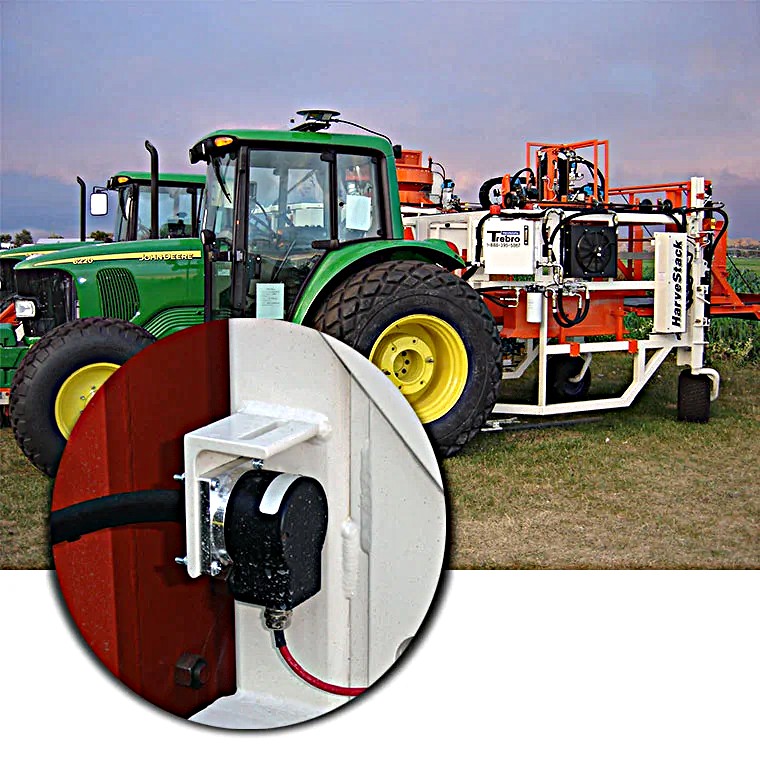
The core application scenario of encoders in agricultural machinery.
1. Precise seeding and fertilization control: The encoder is installed on the drive wheel or seed distribution shaft of the seeder, calculating the travel distance by measuring the number of wheel rotations (or the rotational speed of the seed distribution shaft), thereby controlling the start and stop of the seed dispenser and the amount of seed sown. For example, an incremental encoder outputs 1000 pulses per rotation, and combined with the wheel diameter (e.g., 1 metre), the travel distance can be converted (1 pulse ≈ 1 mm). The system accurately triggers the seed distribution based on the preset plant spacing (e.g., 20 cm). Application example: A corn seeder real-time monitors the travel speed through the encoder; when the tractor accelerates, the encoder pulse frequency increases, and the system automatically increases the seed distribution frequency, ensuring that 1 seed is deposited every 20 cm of soil, with an error ≤ ±1 cm.
2. The adjustment of the cutting and conveying system speed for the combine harvester: The encoder monitors the rotation speed of the cutting drum and conveyor belt, maintaining constant operational efficiency through closed-loop control. For example, when crop density increases, the load on the cutting drum rises, causing the rotation speed to drop, the encoder feedback signal frequency decreases, and the system automatically increases the motor power to compensate for the speed (for instance, maintaining from 1000rpm to 1000±5rpm). Application example: A magnetic encoder is installed on the main shaft of the cutter of the wheat combine harvester, monitoring the cutting speed in real-time. If lodged crops are encountered, the encoder detects a sudden drop in speed, and the system automatically adjusts the feed rate to prevent drum blockage.
3. Automatic driving and path tracking for tractors: An encoder combined with GPS positioning measures the front wheel steering angle and travel distance, enabling automatic navigation. For example, an absolute encoder records the steering shaft angle (e.g., 'left deviation 15°'), and combined with the GPS coordinate offset, the system calculates the corrected steering wheel angle to ensure the tractor follows the preset furrow (deviation ≤ ±5cm). Application example: When operating in the field, the front wheel steering shaft encoder of the smart tractor provides real-time angle data. When the GPS signal indicates a deviation from the preset path of 0.3 meters, the encoder works with a servo motor to automatically adjust the steering wheel angle (e.g., 3°) to correct the travel trajectory.
4. Precision control of pesticide application by agricultural drones: Encoders measure the motor speed or propeller angle of the drone, adjusting the spray pump flow rate in conjunction with flight speed. For example, a photoelectric encoder monitors the propeller speed (reflecting lift requirements); as the drone accelerates, the encoder signal frequency increases and the system proportionally increases the pesticide application amount (e.g., spraying 2L per mu at a speed of 10m/s, increasing to 3L per mu at 15m/s). Application example: The pesticide spraying drone measures horizontal flight speed through a rear encoder; when it enters the edge of the farmland and slows down, the encoder feedback signal frequency decreases, prompting the system to automatically reduce the nozzle flow rate to avoid excessive pesticide application in the edge area.
5. Automation Equipment Positioning for Greenhouse: Encoders are used for displacement measurement in greenhouse curtain machines and irrigation trusses, enabling automated start and stop. For instance, an incremental encoder installed on the curtain machine's roller outputs 1000 pulses for every metre rolled, and the system stops the motor after counting the predetermined height (e.g., 'curtain raised by 2 metres') at 2000 pulses. Application Example: The shading net curtain machine of the smart greenhouse is precisely controlled by the encoder for the unfolding area; when the light intensity reaches 30000 lux, the encoder counts to 1500 pulses (corresponding to the shading net being unfolded by 1.5 metres), and the system stops the curtain operation.
Challenge 1: Dust (such as soil and straw debris) and rainwater can easily infiltrate the encoder, leading to contamination of the code disc or short circuits. Solution: - Use a fully sealed metal casing (such as stainless steel) with a silicone seal ring (IP68 protection level); - Replace photoelectric encoders with magnetic encoders to avoid dust obstructing the light path (magnetic encoders sense position through changes in the magnetic field, unaffected by dust).
Challenge 2: Resistance to mechanical vibration and shock: During operation, a combine harvester can experience vibration levels of up to 50G, causing ordinary encoders to suffer from loose components or signal jumps. Solution: - Use potting resin to fix the circuit board inside the encoder, enhancing vibration resistance; - Use vibration dampening mounts during installation to reduce the transfer of mechanical vibrations (such as rubber cushions reducing vibration amplitude by 30%).
Challenge 3: Stability in wide temperature environments: In northern regions, winter field temperatures can drop to -30°C, while in southern areas, summer temperatures can reach 50°C, making ordinary encoder components prone to failure. Solution: - Select military-grade wide temperature components (such as Hall sensors that operate from -40°C to 85°C); - Design the encoder casing with heat dissipation fins, using a fan for forced cooling when temperatures exceed 60°C.
Future development trends
Multi-sensor fusion: integration of encoders with visual sensors, GPS, and inclinometer to achieve multi-dimensional precise control of 'position, image, and posture' (e.g., drones using encoders and cameras for automatic obstacle avoidance). Wireless transmission and the Internet of Things: adopting technologies such as LoRa and 5G for remote monitoring of encoder status (e.g., mobile app real-time alerts when a seed drill encoder malfunctions). Intelligent diagnostics and predictive maintenance: encoders equipped with AI chips analyse data such as vibration and temperature to predict gear wear or motor faults (e.g., alerts 72 hours in advance to replace encoder bearings). Low power design: developing micro-power encoders (standby power<1mW) for solar-powered agricultural equipment to extend battery life. Encoders convert mechanical movement into digital signals, infusing the essence of 'precise control' into agricultural machinery, promoting the transformation from traditional to smart agriculture, playing a key role in improving operational efficiency (e.g., 30% increase in sowing efficiency) and reducing resource waste (e.g., 20% reduction in seed usage).
文章推荐
Delburg & ACCU-CODER Encoders: Direct Drop-in Replacement for Encoders from Europe, America, Japan & South Korea
Encoder Products Company Introduces 36RT/H Accu-CoderPro® High Resolution Programmable Encoder
Installation Methods of Encoders
Transmissive vs Reflective Photoelectric Encoders: Principles, Pros & Cons, and Selection Guide
High-Precision Positioning: Grating + Encoder Dual-Loop Servo System Eliminates Mechanical Transmission Errors
Poor Positioning Accuracy? Stop Blaming Encoders! The Real Errors Come From Transmission Chains
Encoder resolution and accuracy: What’s the difference?
Poor Positioning Accuracy? Stop Blaming Encoders! The Real Errors Come From Transmission Chains
High-Precision Encoders: Reliable Motion Sensing Solutions for Industrial Automation
Industrial Encoder Purchase Risk Avoidance Guide: Full Analysis of Channel Screening, Qualification Verification and Practical Implementation
Frequent Production Line Shutdowns & Positioning Deviations? The Encoder Pitfall 90% of Factories Fall Into!
Encoder Electrical Anti-Interference Solution, Universal for New Project Design and Old Equipment Rectification
Long Lead Time of Imported Encoders? Choose DELBURG for Cost Reduction & Technical Renovation
What Makes High-End Encoders Stand Out? 6 Core Standards for Industrial High-Quality Performance
Encoder Selection Guide
Encoder Fault Diagnosis and Prevention Checklist (Including On-site Inspection List)
Encoder Angular Accuracy: In-depth Conversion Manual for Arcminutes/Arcseconds
Professional Selection Guide for Servo Motor Encoders
DELBURG Encoder Brand Story
Zhuhai Delburg Technology Co., Ltd.
Rm.407, Building 4, No. 615 Huawei Road,
Xiangzhou District, Zhuhai City, 519000, China
Phone: 86-756-3363470
Email : delburg123@outlook.com

点击右上角
分享给朋友吧

Copyright © 2005-2015 MySite Ltd. All Rights Reserved. 粤ICP备2024309016号
